Six Weeks, Three Foldables, Zero Patience for Gimmicks: Our Honest 2024 Verdict
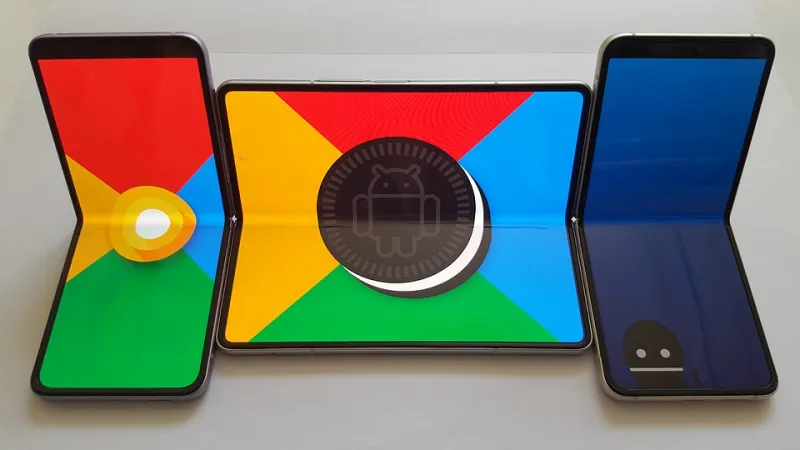
Photo: The photo: Own work The logos: Google LLC, CC BY 3.0, via Wikimedia Commons
Foldable phones have had a reputation problem. For years, early adopters paid flagship-plus prices for devices that creased, cracked, or simply felt like expensive prototypes. The pitch was always "this is the future" — but the future kept getting delayed by fragile hinges and software that clearly hadn't caught up with the hardware.
So when we lined up the Samsung Galaxy Z Fold 6, the Google Pixel 9 Pro Fold, and the OnePlus Open for a six-week real-world test, we weren't coming in as fanboys. We were coming in as skeptics with a checklist. Here's what actually happened.
How We Tested (And Why It Matters)
We didn't just sit in a lab tapping benchmarks. Each device was used as a primary phone by a different team member — commuting in Chicago, working from coffee shops in Austin, and traveling between coasts. We tracked hinge durability through daily open/close cycles, monitored display crease visibility under different lighting conditions, measured real-world battery performance, and paid close attention to how well each device's software actually took advantage of the larger inner screen.
This wasn't a spec sheet comparison. This was life with a foldable.
Samsung Galaxy Z Fold 6: The Veteran That Keeps Iterating
Samsung has been doing this longer than anyone, and the Z Fold 6 shows it. The hinge mechanism feels genuinely solid — after six weeks of aggressive daily use, there was zero perceptible looseness or wobble. The device also felt noticeably lighter and less brick-like than its predecessor, which matters more than you'd think when you're pulling it out of your pocket 80 times a day.
The inner 7.6-inch display is stunning in good lighting, and Samsung's software — particularly its taskbar and multi-window capabilities — remains the most mature in this category. Running two apps side-by-side actually feels natural here, not forced. For productivity-focused users, the Z Fold 6 is still the benchmark.
But here's the thing: the crease is still visible. Not distracting during video or browsing, but catch it under direct sunlight or at the wrong angle and it's right there. After six years of foldables, Samsung still hasn't solved this. It's not a dealbreaker, but at $1,899, it should probably be closer to one.
The cover screen — the narrow outer display — remains a compromise. It's usable for quick tasks, but typing anything longer than a text message on it feels like a punishment. You'll be reaching for the inner screen constantly, which means the cover screen's utility is mostly limited to notifications and music controls.
Best for: Power users, multitaskers, and anyone who wants the most mature foldable software ecosystem available
Google Pixel 9 Pro Fold: The Smartest Newcomer
Google's second-generation foldable is a significant leap from the first Pixel Fold, and it's the device that surprised us most during testing. The 8-inch inner display is the largest in this comparison and, crucially, has a more natural aspect ratio than Samsung's — it feels less like a skinny book and more like a small tablet.
The crease situation is actually better here. It's present, but Google's anti-reflective coating and the display's brightness calibration do a better job of minimizing its visual impact in everyday use. After a week, most testers stopped noticing it.
Where the Pixel 9 Pro Fold really separates itself is software intelligence. Google's AI features — call screening, live translation, and the Gemini integration — feel genuinely useful rather than demo-ware. The camera system is exceptional, as expected from any Pixel device, and it's the only foldable in this group where the photography experience feels fully competitive with the best non-folding flagships.
The hinge is stiff — stiffer than Samsung's — which some people will love (feels more durable) and some will find annoying (one-handed opening is a workout). Battery life was the best of the three in our testing, comfortably making it through full workdays.
At $1,799, it's slightly cheaper than the Z Fold 6 and, honestly, a better overall package for most people.
Best for: Android purists, camera enthusiasts, and anyone who wants the most polished software experience on a foldable
OnePlus Open: The Underdog That Punches Hard
The OnePlus Open is the oldest device in this comparison — it launched in late 2023 — but it still holds up surprisingly well, and its street price has dropped considerably, making it the value proposition of the group.
The hinge is the smoothest of the three. Opening and closing the OnePlus Open one-handed is genuinely effortless, and after six weeks, it showed no signs of loosening. The outer screen is also the most usable cover display in this lineup — wider, more comfortable for typing, and better optimized for quick interactions.
Where OnePlus falls behind is software longevity. OxygenOS has solid foldable-specific features, but Google and Samsung both have longer track records of update support. If you're buying a device at this price point and planning to keep it for three-plus years, that matters.
Camera performance is good but not great — fine for everyday photos, but it trails the Pixel noticeably in low-light situations.
If you can find it around $1,400 or less, the OnePlus Open is a legitimately compelling option that the mainstream tech press has somewhat underrated.
Best for: Budget-conscious foldable buyers, people who prioritize hinge feel and cover screen usability
The Crease Problem: An Industry-Wide Honest Assessment
Every foldable in 2024 has a crease. Every single one. Some are better than others, but none have eliminated it. If a visible line down the middle of your display is going to drive you crazy, you're not ready for a foldable — and that's a completely valid position.
So Are They Actually Worth It in 2024?
Here's where we land after six weeks: yes, with conditions.
Foldables have genuinely matured. The durability anxiety of the early days has largely been addressed. The software — especially on Samsung and Google — has caught up to the hardware in meaningful ways. Using a foldable as a daily driver no longer feels like beta testing.
But they're still not for everyone. If your primary use cases are social media scrolling, casual photography, and texting, a foldable's inner screen won't change your life. You'd be paying a $600-800 premium over a standard flagship for a feature set you'll use occasionally.
However, if you're someone who regularly works from your phone — reviewing documents, running multiple apps simultaneously, reading long-form content, or taking video calls — the productivity gains are real and measurable. For that user, a foldable in 2024 isn't a gimmick. It's a legitimate upgrade.
Our pick if you're buying today: Pixel 9 Pro Fold for most people, Z Fold 6 if Samsung's software ecosystem is important to you, and OnePlus Open if budget is the primary constraint.
The future of phones is folding. It just took a little longer to get here than the hype suggested.